JMO Victoria is a voluntary committee of prevocational doctors who represent, advocate and support all prevocational doctors in Victoria by assessing and improving prevocational education and training, career progression, accreditation and wellbeing. This newsletter details the achievements and projects of JMO Victoria in 2025 and how this will translate into their key priorities for 2026.
The Committee went into 2025 with three priorities:
- Continuing to build awareness of JMO Victoria’s work and by association, the PMCV’s work, amongst prevocational doctors and other relevant stakeholders.
- Providing information, education and support regarding the ongoing implementation of the National Framework, and the changes for PGY1 and PGY2 doctors in Victoria including the revised Intern match system now known as the Victorian Intern Allocation (VIA).
- Continuing to serve as a channel for raising concerns—such as those related to accreditation, prevocational medical education, and other relevant areas—to the PMCV on behalf of prevocational doctors.
These deliverables were addressed by each pillar of the Committee as they planned, produced and executed at least one key project.
Education
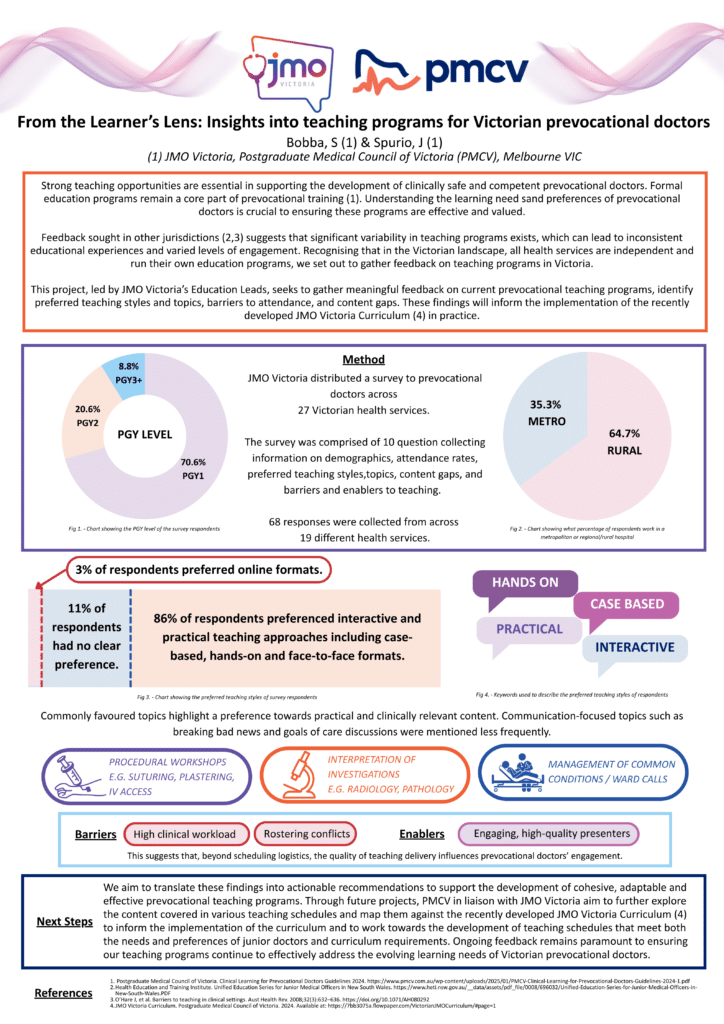
The primary goal for the Education team was to establish a clear picture of what teaching programs exist for PGY1 and PGY2 doctors through review of intern teaching schedules and a Teaching Program Survey that aimed to inform future initiatives and build shared resources.
The survey was distributed statewide, to which responses from across multiple health services were received. In combination with the Victorian JMO curricula, the survey produced a comprehensive overview of the teaching activities currently in place, spanning across structured didactic sessions, case-based learning, and practical skills teaching.
By examining this dataset, the Education team aims to identify common themes, as well as highlight potential gaps in training content and delivery. Understanding these patterns will allow JMO Victoria to make evidence-based recommendations for enhancing JMO teaching and identify areas where additional support or innovation may be required. Preliminary findings were featured as part of the poster presentation at the 2025 Australian and New Zealand Prevocational Education Forum (ANZPMEF), inviting broader discussion around shared challenges and opportunities in JMO education.
Looking forward, the 2026 Education team will be converting the content of the Victorian curriculum into a centralised resource bank that will be accessible to JMOs across Victoria. In addition, they will be drawing on shared curriculum content, high-quality teaching materials, and examples of best practice to inform a campaign regarding ‘what makes good education?’
Medical Workforce
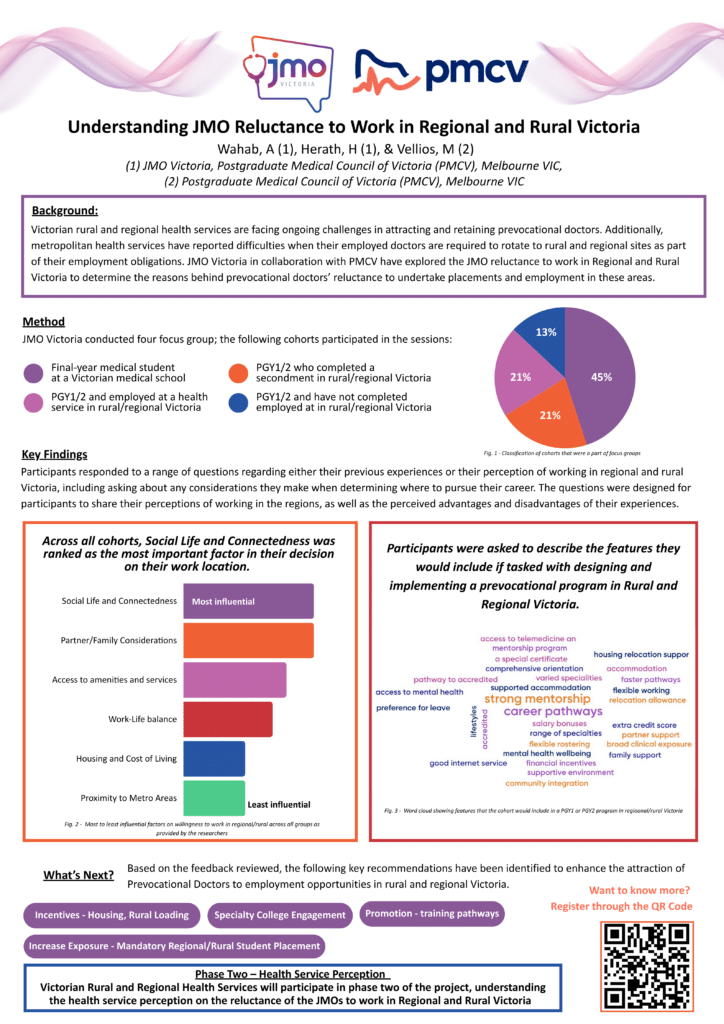
The key achievement of the Medical Workforce team was the Rural Health Focus Group Project. This project was a joint initiative between PMCV and JMO Victoria that explored factors influencing prevocational doctors’ decisions regarding rural placements. Four comprehensive focus group sessions were conducted, engaging final-year medical students and PGY1/2 doctors. The project sought to capture honest reflections and suggestions from early-career doctors about their career intentions and barriers to rural practice. The insights gathered informed a formal report submitted to the PMCV Board and the Department of Health with key recommendations aimed at strengthening rural medical workforce sustainability. Notably, the project was presented at the 2025 ANZPMEF Conference, offering valuable exposure and peer engagement.
In 2026, the Medical Workforce team aims to conduct a review of the PGY2 Match and improve the information distributed regarding the Victorian Intern Allocation and the Victorian Rural Preferential Allocation in the lead-up to this year’s Matches.
Accreditation
There were several key priorities within the Accreditation portfolio throughout 2025. The first was the six-monthly check-in for the JMO Accreditation Survey, which involved a review of responses from 2024. Following the review, the survey was refined for 2025 to include the collection of JMO feedback related to the introduction of EPAs and the impact of the National Framework. The survey was redeployed mid-year, remaining continuously open to increase access to the survey. Results will be reported in the coming months.
There were also efforts to educate prevocational doctors about the Accreditation process, their rights and commonly misunderstood areas through the “Did you Knows” of Accreditation campaign. This resulted in an increase in JMO engagement with the associated Accreditation survey visits.
This initiative will continue in 2026 through different mediums, including video resources for JMOs to better understand the Accreditation survey program and an update of the JMO Victoria website.
Media, Marketing and Events
Over the year, the Media, Marketing and Events team has delivered high-impact events, strengthened JMO Victoria’s digital presence, and enhanced member engagement. This was achieved by collaborating with other pillars to maintain an active social media presence and making updates to the JMO Victoria website to ensure information was current and relevant.
The team was also actively involved in the promotion of various JMO Vic and PMCV events throughout the year as well as advertising professional development opportunities.
Looking to 2026, the team will be prioritising the Annual Cocktail Night event. They will also aim to analyse JMO Victoria’s current social media presence to determine how JMO Victoria can optimise engagement with prevocational doctors across the state.
Welfare
The most significant achievement of the Welfare pillar was the 2025 JMO Cocktail Night sponsored by Osler which took place on the 20th of September 2025 at Quarterhouse Rooftop, Docklands.
The event hosted 115 prevocational doctors from across Victoria, in addition to PMCV board members and the Prevocational Doctor of the Year, facilitating an evening dedicated to socialising and networking. The occasion was executed efficiently and received favourable feedback, with ticket sales rising by approximately 30–35% compared to figures from 2024 (90 vs 124 ticket sales).

This year, the Welfare team will be focusing on rural and regional engagement and how to better integrate JMOs into their local communities and groups.
Overall, 2025 was an incredibly successful year for JMO Victoria. The team worked cohesively, proactively and collaboratively together to improve the lives of prevocational doctors in Victoria.
The 2025 JMO Victoria Committee would also like to acknowledge the work of the JMO Victoria Health Service Representatives (HSRs) throughout 2025. In 2025, the HSRs grew to a group of 58 PGY1s and PGY2s from across Victorian health services. This group played a significant role in enabling JMO Victoria to identify and escalate concerns pertaining to prevocational doctors within their network, as well as serving as an effective channel for the distribution of information, including promotional materials and surveys.
2026 brings an opportunity to continue building on JMO Victoria’s momentum to bolster their impact in addressing prevocational doctor education, accreditation, workforce and wellbeing issues in the state through further initiatives and projects with PMCV.
PMCV would like to congratulate JMO Victoria and the JMO Health Service Representatives for all their incredible achievements throughout 2025 and look forward to supporting their initiatives going forward.