Supporting prevocational doctors (JMOs) is the main objective for PMCV since our founding in 1999. In this edition of PMCV Insights, we will be exploring how PMCV supports prevocational doctors through various initiatives both internally and with our stakeholders.
Since its establishment in 1999, PMCV has been dedicated to supporting prevocational doctors (JMOs).
We had the honour of hearing from Former Chairs of the PMCV Board and other key stakeholders about the significant role PMCV has played in supporting prevocational doctors throughout their training journey.
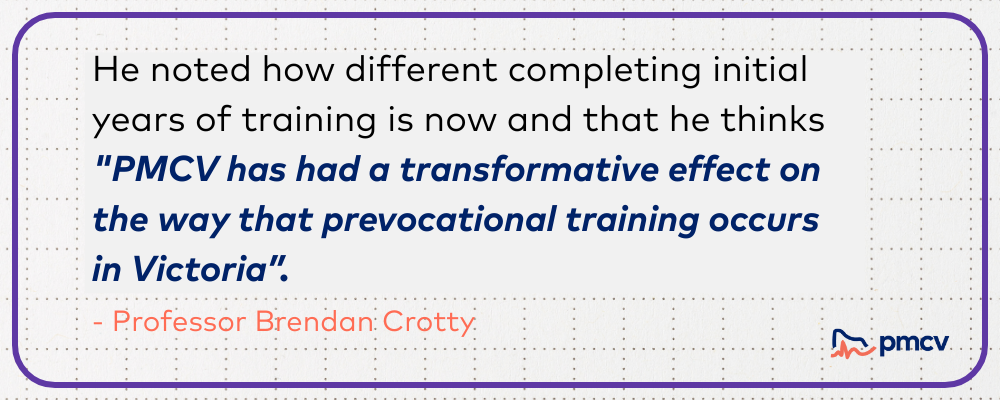
Professor Brendan Crotty remarked that during his internship, there was minimal support or emphasis on education and wellbeing.
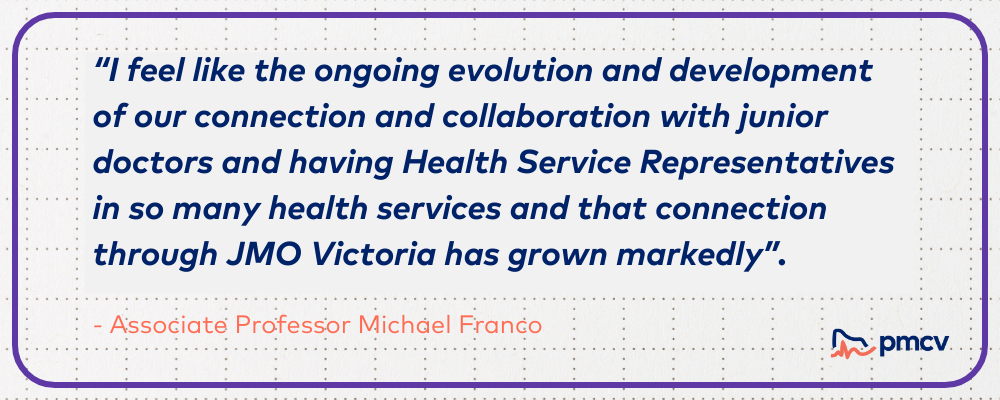
Associate Professor Michael Franco, the current Deputy Chair of the PMCV Board, revealed his unique perspective on PMCV’s journey having been involved in PMCV since he was an Intern. “When I think about the impact that the PMCV has had over these years, I think one of the most important things to me… is that it’s given JMOs a really meaningful voice ensuring that JMOs are in the room when issues concerning them are discussed.”
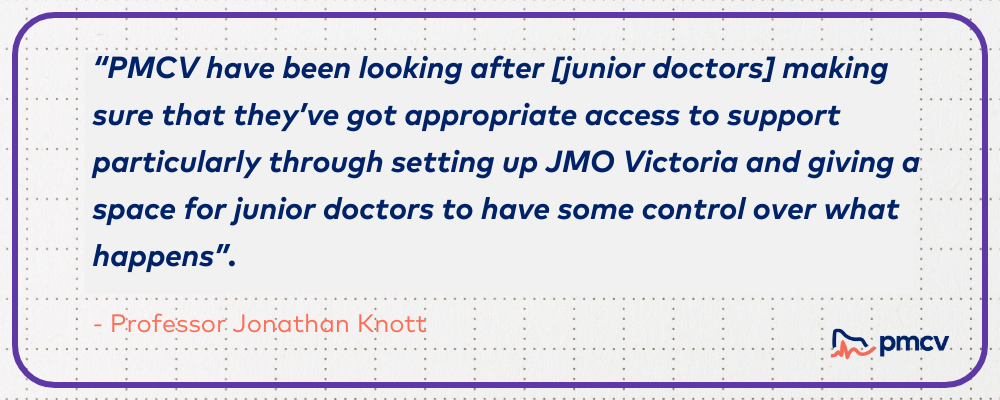
The Victorian JMO Forum was established in 2005 and consisted of interns and prevocational doctors from each health service in Victoria, who met regularly according to Brendan Crotty. However, one of the biggest milestones of our continuous efforts to support and listen to JMOs, was the formation of JMO Victoria as an evolution of the former JMO Forum in 2021. This collaborative community was established for JMOs to support each other throughout their prevocational medical training experience increasing overall wellbeing. It is auspice by PMCV and led by a team of volunteer prevocational doctors who represent, advocate for, and support all their fellow JMOs in Victoria. Jonathan explained that this was a natural addition to the welfare initiatives of PMCV.
Beverly Sutton, CEO of Health Education Australia Limited, agreed that since the pandemic “bringing in wellbeing has been really important [and] what I love [is] that [PMCV has] actually prioritised engaging JMOs and encouraging them to have a say and to be involved in Committee Meetings, etc. which is really lovely”.
Since JMO Victoria was introduced, it has gone through a few different iterations and grown to become a flourishing community now with over 4,000 community members in their Facebook group.
We also had the opportunity to speak with Dr Adam Walsh who served as the Co-Chair of the JMO Victoria team in 2024. He outlined that for the duration of his tenure he “really enjoyed connecting with other JMOs who were also passionate about the prevocational space across health networks working on all the different projects which included a Cocktail Night which was very successful”.
He also highlighted the experience of attending the National Prevocational Medical Education Forum – “we presented a number of different projects. It was just a great time to connect with one of the other JMO leads and members of the PMCV.”
When asked to provide advice to anyone who wants to take on a role in the JMO Victoria Committee, Adam had several insights to share.
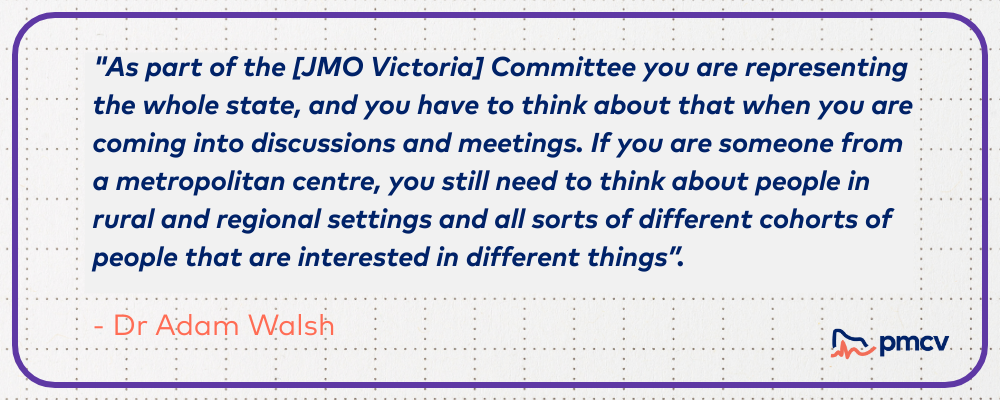
He also noted that there is a time commitment required, and it needs to be utilised wisely due to the Committee being refreshed each year. Committee members have to come in with realistic expectations as their “roles are ongoing commitments and do require a bit of work”. To relieve the time restraints Adam stressed the importance of honouring and continuing existing projects whilst allowing space for innovation and ideation of new initiatives to create the best outcomes during their time on the Committee.
During his time as Co-Chair, Adam also became the Prevocational trainee representative on the PMCV Board continuing his responsibilities in a leadership position for another three years.
He praised the direction PMCV is going as he believes “that the focus on wellbeing for JMOs is beginning to gain a little bit of traction with the PMCV, it’s definitely a body that has the capacity to provide another layer of protection for JMOs particularly in regional and rural areas they may not have clearly specified escalation pathways for issues of Accreditation”.
The most recent initiative that PMCV and JMO Victoria have launched is the introduction of the JMO Victoria Health Service Representatives (HSRs). This role has been appointed at all Victorian health services and acts as the connection between prevocational doctors, PMCV, health services and JMO Victoria.
Their primary role is providing valuable insights into how National Framework implementation is progressing on a local level within health services, which will ultimately strengthen the prevocational training experience for current and future cohorts. You can read more about what the HSR role entails here: https://www.pmcv.com.au/blog-the-role-of-the-hsr/
Adam spoke on the HSRs and how the initiative is “a relatively fresh project” that has “worked well”.
Michael shared his enthusiasm for this development stating that it is a “really exciting time for the PMCV”.
As we look to the future PMCV is constantly seeking to improve processes and systems to continue learning from the perspectives of, and subsequently supporting, the development of safe, high-quality, thriving, prevocational doctors.
Jonathan shared that moving forward “we need to keep being the organisation [that] when it comes to junior doctors you come to us”.
Adam imparted that he thinks PMCV’s relationship with JMOs is “definitely changing…it naturally evolves as a medical student your first interaction with the PMCV is the Match… but it is a very surface level interaction”. He noted that “[JMOs] are developing a bit more of an appreciation for the role the PMCV does protecting JMO posts” and our efforts to uplift current and future prevocational doctors.
PMCV would like to thank Dr Adam Walsh, Associate Professor Michael Franco, Beverly Sutton, Professor Jonathan Knott and Professor Brendan Crotty for their contributions to this piece.