

Clinical Context
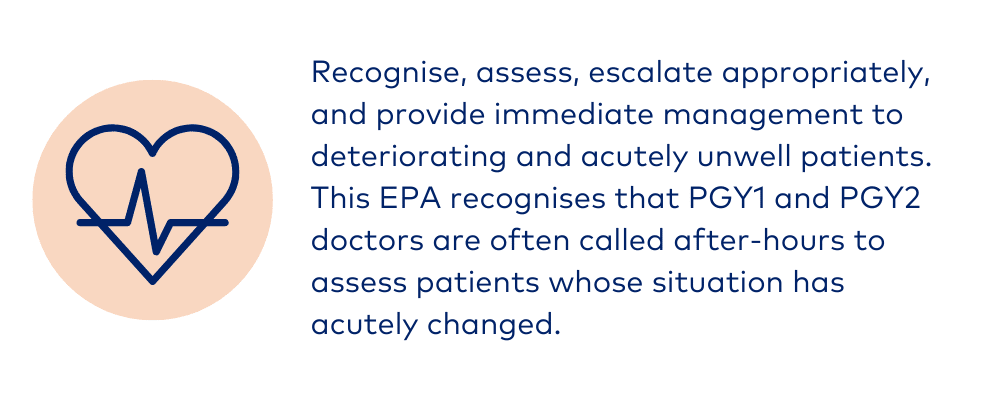
EPA 2 – Recognition and care of the acutely unwell patient applies in any clinical context but the critical aspects that differentiate it from EPA 1 – Clinical assessment are for the PGY1/PGY2 doctor to:
- recognise the acutely unwell and/or deteriorating patient (including deterioration in mental health)
- act immediately, demonstrating a timely approach to management
- escalate appropriately.
For the purpose of EPA assessment, deteriorating patient is defined as:
“Acute deterioration includes physiological, psychological and cognitive changes that indicate a worsening of the patient’s health statues and require a timely response from the prevocational doctor”. Examples of these situations include:
- A patient where the prevocational doctor escalated and sought assistance early
- A patient requiring attention through the hospital’s escalation policies (Ie. MET, Urgent Clinical Review or other)
- A patient where the prevocational doctor is required to respond within 30 minutes
Training Material
EPA 2 Task Descriptors
The EPA 2 – Recognition and care of the acutely unwell patient assessment form lists the tasks that may be observed, noting that there is no requirement to observe all components. Prevocational doctors will be asked to tick the relevant tasks, but this may be changed by the assessor.
Click to view task descriptors
- Recognise clinical deterioration or acutely unwell patients.
- Respond by initiating immediate management, including basic life support if required.
- Seek appropriate assistance, including following local processes for escalation of care.
- Communicate critical information in a concise, accurate and timely manner to facilitate decision-making.
- Lead the resuscitation initially, and involve other necessary services, such as intensive care or retrieval services.
How to Put EPA 2 into Practice
The EPA assessor will often not be present while the acutely unwell patient is being assessed (e.g., a Medical Emergency Team (MET) call after hours) and it is anticipated that assessment by direct observation will be less common than for the other three EPAs. The assessment should include input from someone who was present. (In the example of the MET call this could be your registrar or a member of the MET team.)
Opportunities to complete EPA 2 – Recognition and care of the acutely unwell patient include:
- A short discussion with the MET team or a supervising registrar after the deterioration event is completed
- If a patient is identified on a ward round who had a MET call the prior evening, then Term Supervisor may choose to discuss the approach taken by the prevocational doctor at the end of the ward round
- In a General Practice setting, a deteriorating patient may require an ambulance – this can be discussed after the event, perhaps at the end of the day
- In the Emergency Department, the supervisor may discuss a patient for whom senior support was required. This may be done close to the event or at the end of the shift
Areas to consider for feedback:
- Did the prevocational doctor recognise the urgency of the situation (and can they explain why)?
- What did the prevocational doctor plan to do first?
- When did the prevocational doctor recognise help was needed and how did they get this?
- Can the prevocational doctor outline the next steps they might have undertaken if help was delayed?
- Can the prevocational doctor identify any ways this deterioration could have been avoided (there may not be any)?
In discussing EPA 2 – Recognition and care of the acutely unwell patient, you should also consider the wellbeing of the prevocational doctor – do they need to discuss and debrief or need further support to process the event?