Delivering recruitment initiatives for health services across Victoria has been an integral part of PMCV’s functionality since our organisation’s founding in 1999. In this edition of PMCV Insights, we will be delving into how the Match process has evolved throughout the years.
The origins of PMCV’s Allocation and Placement Service (formerly Computer Matching) is in the predecessor organisation, the Victorian Medical Postgraduate Foundation (VMPF), whose primary role was the administration of the Medical Computer Match. Former VMPF Administrative Director Ann Mansie (formerly Ann Dancer) was heavily involved in the Match process that was first conducted in 1972.
She explained the technology utilised by the VMPF was a “Fortran engineering program linked to the University of Melbourne’s mainframe computers” as personal computers were not widespread at the time. The Match covered a range of health service positions from Intern up to both PGY3 and 4.
Ann outlined that all preferences were submitted in a paper-based format so a representative from VMPF, which was based in Toorak at the time, would make their way down to the University of Melbourne to “collect all the printouts to [manually] check” each application.
Therefore, the VMPF team manually checked hundreds of printouts, making any necessary changes before the final printout was done and results were sent out to both the candidates and the health services taking part in the Match.
“As you can imagine it was very time consuming” Ann mentioned but impressively within her time at the VMPF there were “no errors in any of the Matches”.
By 1995, VPMF was able to transfer the Match applications to individual computers, so they could input and check the data from the printouts without having to leave their offices. This made the process more efficient and was a sign of continuous growth and improvement that would define recruitment initiatives for years to come.
Matches for Radiology positions were already occurring when Ann began her role at VMPF, but they did not undertake the Graduate Nursing and Midwifery Match until 1996 following a request from the Department of Health.
“We had very short notice to get it set up” Ann described, which was quite a challenge at the time. However, she was proud to say that they managed to prepare all the aspects needed to ensure that “it all ran according to plan”.
Each stage of the Match process was essential and the VMPF guided candidates on how to complete them appropriately. Ann noted that one of the greatest challenges was candidate preferences – “…our advice was to [preference] the hospitals wherever you want because they will never know where you put them. Always put the hospital you would love to go to even if you don’t think you have a chance”.
Impressively, VMPF also ran a central reference bureau to support the referee part of the process so that “anybody participating in any level of the Match could submit the names of people as their referees and VMPF would write to them…and the hospitals would then send the names of candidates they wanted to see closed references for…and we used to copy these references and send them off to the hospitals to assist in their selection process”.
Ann emphasised the commitment and dedication of the small team at VMPF, who “were extremely proud of being involved in the Matches and the success of the Matches”.
Former Board Chair of PMCV Professor Napier (Nip) Thomson also shared his thoughts about the success of the Matches, “We got the allocation of positions through computerised Matching…[it] seemed to be working well, I think that took a lot of pressure off hospitals who prior to that basically did their own appointment system”.
In 1999, a decision was made by the Medical Training Review Panel to establish Postgraduate Medical Council’s (PMCs) in each state and territory of Australia. As outlined in our previous blog: (https://www.pmcv.com.au/news/blog-the-establishment-of-pmcv/) following discussions the role of the VMPF was redefined and the PMCV was founded.
Not long after PMCV’s founding a transition of the Matching process from VMPF to the PMCV was undertaken in 2000.
Carol Jordon, PMCV’s Executive Officer at the time notes that as the VMPF owned the Computer Matching system she “…worked with them over the first 12 months to get trained up in the system and then transition the system to the new organisation the following year.”
The Match very quickly became a vital part of PMCV’s role as an organisation.
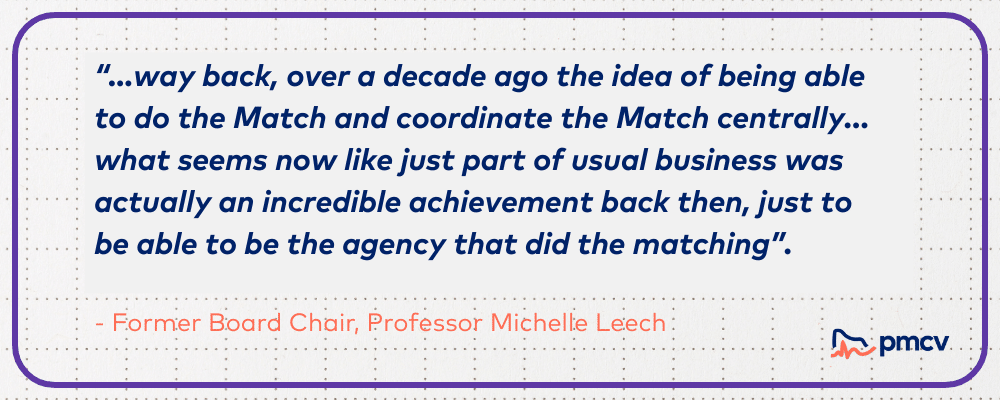
PMCV’s recruitment initiatives have continued to evolve and change since taking on the Match process. One of the notable developments to the Match process since then was the movement to the Allocation and Placement Service in 2018.
“We used our resources wisely to gain the support of the Department (of Health) to develop the new Allocation and Placement System,” Carol explained. “It was a big project that was a few years in the making which set [PMCV] up well for increased interest from other colleges to run matching processes”.
Michelle noted the significance of these system upgrades – “…we’ve tried to reduce the workload for applicants by having a single application, to me that’s a huge achievement”.
Another considerable evolution occurred during the pandemic as one of the most substantial parts of the recruitment process – interviews had to be shifted online with a short turnaround time.
Michelle emphasised that “getting that video interview up and running…the capacity for adaptation during that time in the PMCV engine room…was absolutely breath-taking”.
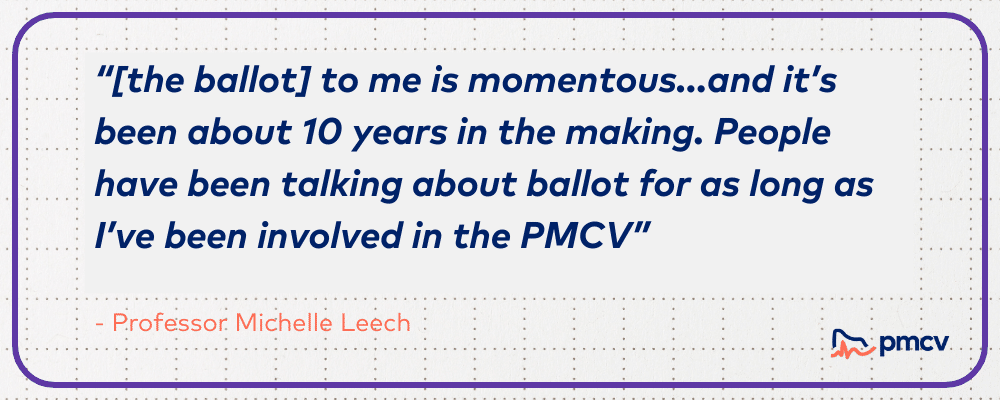
One of the most significant achievements occurred very recently being the transition towards an optimised ballot system for the Intern Match.
Michelle noted that in her 10-year involvement with PMCV she believes that it was one of organisation’s biggest achievements which “in a way took a lot of back leg work before [this] year and collaboration and stakeholder engagement” but it has now come to fruition in the 2025 Intern Match.
Former Board member and Chair Jonathan Knott echoed this sentiment although there may be early anxieties amongst candidates using the new system, “from a system level it is absolutely the right thing to do it is going to be terrific and for the [prevocational doctors] it is definitely the right way to do it…I’m quite excited about what is going to happen there”.
Whilst even in the present day, there are challenges faced with technological limitations and the transfer of information overall, the consensus among those that have been heavily involved in the Match process is that it has been a long-lasting success. PMCV are very proud of the origins and rich history of this process and how it has continued to support health services and Match candidates to this day.
PMCV would like to thank Ann Mansie, Professor Napier (Nip) Thomson, Carol Jordon, Professor Michelle Leech and Professor Jonathan Knott for their contributions to this piece.